
About Stupa
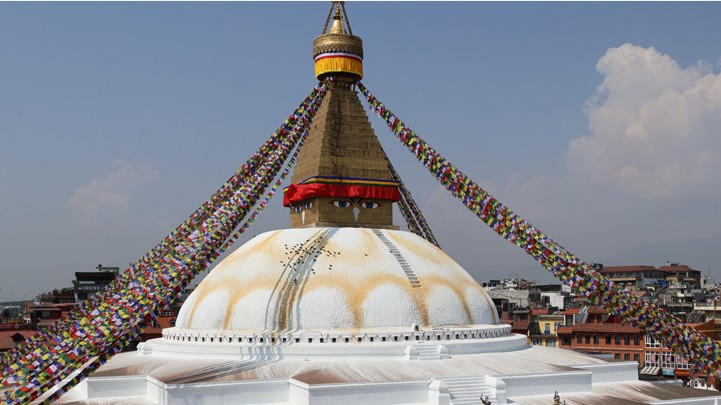
The Stupa, structured with a domed hemispherical form, is a form of the Buddha. It contains relics, inscriptions detailing major events of his life, and sacred places where these events occurred. In ancient India, there was a tradition of erecting domed tombs over the buried bodies of saints or Kings. The purpose of building a stupa is to foster deep faith in great spiritual teachers. People circumambulate the stupa to absorb blessings and to commemorate the great master. The Buddhist emperor, Ashoka, in the third century, built many stupas across India containing relics of Buddha.
According to the Sutra relating to Shariputra’s relics, the Buddha enshrined the relics of Shariputra, one of his disciples, in the layman’s house for followers to worship. The followers could not worship the relics as the layman went out by locking the doors. Therefore, the Buddha ordered the stupa to be built to house the relics of Shariputra. He instructed the stupa to have ascending steps, a circular vase base, a square base, the spire with thirteen steps, and at the top a parasol and a jewel. As the stupa-building culture was already established by the Buddha shortly after his passing, the relics were divided among eight kings to build commemorative stupas in their kingdoms.
In Buddhism, the stupa is believed to be built in a sacred place, holding full significance for religious devotees who circumambulate it to remove hindrances, illness, and epidemics, bring peace to the world, and promote longevity among local inhabitants, as well as harmony within the entire environment. It draws pilgrims from all over the world because it has been a sacred embodiment of the Dharma.
What does a Buddhist stupa symbolize?
It embodies the most profound and enduring symbols, revealing the Buddha’s body, enlightenment, the path that leads to awakening, and the five elements. The first square base to be engraved with lions in four directions is the lion throne on which the stupa is placed, similar to the one on which the Buddha sits. The Buddha’s locked legs in the Vajrasana posture are the four square steps rising above the lion throne, which symbolizes the solidity and stability of the earth. Below the vase or dome, the eight square steps represent the stomach on the forehead and backbone in the back.
The vase or dome symbolises the heart of Buddha, which represents the compassionate mind of Buddha, and the womb of the universe. Above the dome, in the wide middle square step of three square steps, there are pairs of eyes in the four directions, gazing over the four directions, although the eyes at the head of Buddha, which exist in the harmika. Above the three square steps is the harmika of thirteen steps of the spire, which represents the head of Buddha that symbolizes the stages of realization along the Bodhisattva path. The upper parasol above his head represents an emblem of royalty; the moon, sun, and flame symbolize enlightenment.
It represents the symbols of the five elements. The square base symbolizes the element of Earth, representing stability and a solid foundation. The dome symbolizes the element of water; the harmika, rising above the dome, symbolizes the fire element. The upper parasol and moon-sun symbolize air and space elements, respectively.
Eight types of stupa and their meanings
The eight great stupas in Buddhism commemorate the major events of Shakyamuni Buddha’s life. Each stupa holds unique architectural features and spiritual symbolism associated with the life of Shakyamuni Buddha.
1. Lotus Blossom Stupa ( Birth Stupa)
It marks the event of Shakyamuni Buddha’s birth in Lumbini on the fifteenth day of the fourth lunar month. The Stupa of Heaped Lotuses was built by Shakyamuni’s father, Shuddhodana, to commemorate his son’s birth. The Buddha walked seven steps once he was born to every four directions. Surrounding it, the lotuses sprang. Therefore, it was built with a surrounding circular four steps decorated with lotus petals.
2. The Enlightenment Stupa
When Shakyamuni Buddha was about to attain enlightenment under the Bodhi tree at Bodhgaya, the hosts of Mara attacked him so that he could not attain enlightenment. He conquered the hosts of Mara and attained enlightenment at 35 years old. It marks the Shakyamuni Buddha’s attainment of enlightenment.
3. The stupa Turning the Wheel of Dharma
The Shakyamuni Buddha gave his first teachings to five disciples about the four Noble Truths in the deer park of Sarnath. His five disciples built the stupa, turning the Wheel of Dharma, to have each of the four square steps decorated with many small door frames marking the doors that were opened to receive his teachings for all.
4. The stupa of Great Miracles
The Shakyamuni Buddha had not been left by Mara obstruction-free. After the most frequent obstructions, he displayed inconceivable miracles to conquer Mara in Shravasti. He conquered them. The king of Shravasti built the great miracle stupa to commemorate this event.
5. The stupa of descent from Tushita heaven
The Shakyamuni Buddha knew that his mother was in Tushita heaven, the god realm. He ascended to Tushita heaven to confer Dharma teachings to all gods and his mother, and to repay the kindness of his mother. After that, he descended on the 22nd day of the 9th month of the lunar year in Sankasya, Earth. The inhabitants of Sankasya built a stupa with a central projection on each of its four sides, containing triple ladders.
6. The stupa of reconciliation
As Devadatta, cousin of Shakyamuni Buddha, had jealousy to see the progress of Shakyamuni Buddha, he created disputes among the Sangha, allowing the Sangha to split apart. The Shakyamuni Buddha reunited the split Sangha at a place known as Rajagriha. To mark this reconciliation event, Rajagriha inhabitants built a stupa characterized by its four octagonal steps with equal sides.
7. The stupa of complete victory
When Shakyamuni Buddha was eighty years old, he prolonged his lifetime by three months in the supplication of disciples in Vaisali. The great scholars of Vaisali constructed a stupa to commemorate the complete victory stupa characterized by only three steps, which were circular and unadorned.
8. The stupa of Nirvana
The Shakyamuni Buddha passed away at the age of eighty years between two sal trees at Kushinagara. To commemorate his parinivana, the king of Kushinagara built a stupa characterized by its circular bell-shaped dome.