
The Guru Padmasambhava, known as Guru Rinpoche

- The Guru Padmasambhava, known as Guru Rinpoche
- 8 great manifestations of the guru Padmasambhava with different aspects:
- 1. The guru Padmasambhava, as the monk Indrasena
- 2. Padma Raja (Pema Gyalpo) in Oddiyana
- 3. The guru Padmasambhava as Chhoki Dorje (Vajradhara)
- 4. Guru Shakya Senge: The lion of the Shakya
- 5. The Guru Padmasambhava as Raj Guru (Loden Chhoksi
- 6. The Guru Padmasambhava as Senge Dradrok
- 7. The guru Padmasambhava as Dorje Drolo
- 8. The guru Padmasambhava as Nyima Oser
The great Buddhist master the guru Padmasambhava was the great tantric yogi and vidyadhara who introduced the complete teachings of Buddhadharma to Tibet, including the Vajrayana tradition. The great master the guru Padmasambhava is the one who made the vajrayana teachings spread and flourish throughout Nepal, Tibet, Bhutan, and the Himalayan regions of India. The guru Padmasambhava is the emanation body of all the buddhas of the three times, the great vidyadhara of indestructible omniscience and omnipotence. He could see three times of the past, present, and future as clearly as an object placed in the hand-palm; so, most definitely, he could also see what types of teachings would be appropriate for the future generation’s people. Therefore, the guru Padmasambhava had concealed innumerable termas for the benefit of future beings within solid rocks, in lakes, and even within space.
The king Trisong Detsen of Tibet was a dharma king. He brought the Indian abbot Shantarakshita to teach Buddhist teachings to the king, ministers, and people as well. As well as powerful local spiritual forces and local deities were obstructing him, he continued to teach. As most obstructions were in Tibet, Shantarakshita advised the king to invite the guru Padmasambhava, who was meditating on the deity Yangdak Heruka in the Asura Cave at Pharping in the Kathmandu valley. He suggested to the king that guru Padmasambhava had miraculous tantric power to control obstructers. The guru Padmasambhava performed profound spiritual practices to subdue powerful spiritual forces and local deities and transformed them into Dharma protectors. With the guru Padmasambhava’s miraculous tantric power and presence, Samye monastery, the first Buddhist monastery, was built in Tibet.
8 great manifestations of the guru Padmasambhava with different aspects:
1. The guru Padmasambhava, as the monk Indrasena
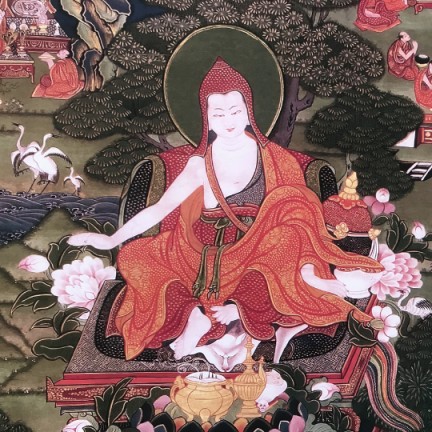
The king Indrabhuti was ruling in the Oddiyana kingdom, which was located in the Himalayan region currently known as the Swat valley of Pakistan. He was loving and caring to his people, and the country was happy and prosperous. But he had been worrying as even his single son had not been of his own from his 108 queens. The king went to consult with an astrologist. He suggested that the king earn virtues by giving wealth and treasures to poor people. The king had given all his wealth and treasures to poor people, leaving nothing. It was not sufficient to reach every poor person. Therefore, he proceeded to Naga Island to find the wish-fulfilling jewels in the palace of the serpent queen. After having listened whole story of the king, the serpent queen gave wish-fulfilling jewels to the king. On his way back to the palace, he arrived at lakes and lotus ponds surrounded by snow-capped mountains. One of the lakes was called Dhanakosha, which was covered with the leaves and petals of lotuses. One particular lotus was unusually huge and did not follow the usual pattern of changing with the seasons. It appeared at the beginning of the monkey year and grew through the seasons. Almost winter, spring, summer, and autumn seasons were about to pass on the tenth day of the tenth month of the monkey year, the lotus opened. The beautiful child, the appearance of an eight-year-old, was sitting inside the lotus. He was dignified, inquisitive, and beautiful. The bees and birds congregated, praising the child. The whole place was pervaded with a lovely musical sound naturally, without music players playing. He was surrounded by dakinies making offerings and even beasts, wild animals, all around paying homage.
The king was happy and felt himself fortunate to see the eight-year-old boy sitting on the lotus flower, untouched by anything, and grown-up on the lotus flower. Indrabhuti, the king of Oddiyana, had been praying for a son, but he had been unable to conceive one. He talked with the lotus-born child and asked to be the prince of his kingdom. After they came to the palace, the king enthroned the lotus-born child as prince. Later, once the lotus-born child was turned into an adult, he was enthroned as the king. He was called Padma Raja, Pema Gyalpo in Tibetan.
2. Padma Raja (Pema Gyalpo) in Oddiyana
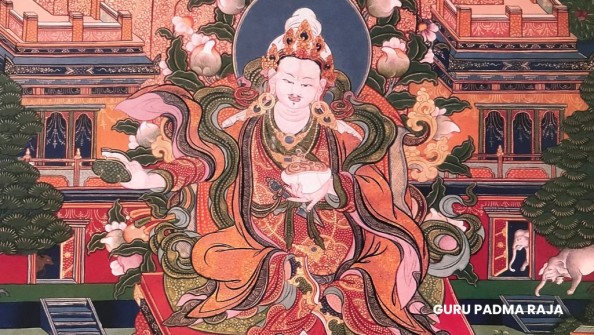
The guru Padmashambhava’s eight manifested forms represent different aspects relating to the phases he had encountered during his whole life. This is the first phase of when he was Padma Raja (Pema Gyalpo) of the Oddiyana kingdom. The king Indrabhuti brought the lotus-born divine child to his Oddiyana kingdom. The divine child was throned as prince until he was young and as king after he was an adult by the king Indrabhuti. Henceforth, the divine child was called Padma Raja (Pema Gyalpo). The Padma Raja had married with daughter of a wealthy man of Oddiyana. Although he was the king and a married person, he wanted to experiment with his aggressions, sexuality, married life, love, and delightful life. He realized the world around him was not all delicate anymore. One day, he began to experiment with his aggressions, dancing on the roof of the palace holding a vajra and trident. It happened to drop. One of the minister’s son and wife were killed by the vajra hit to the head of the son and the trident struck to the heart of the wife. The wildness of exploring things caused him to be exiled. then, he had to charnel ground of Silwa Tsal.
3. The guru Padmasambhava as Chhoki Dorje (Vajradhara)
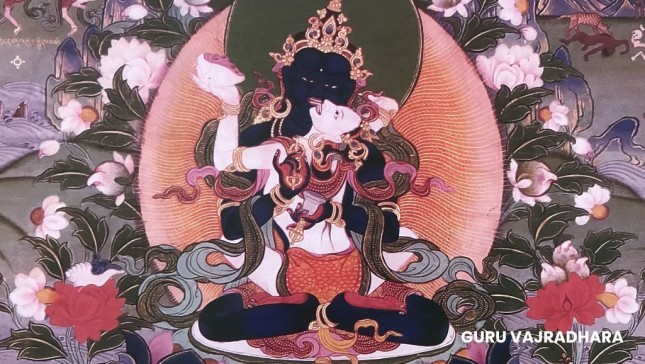
The guru Padmasambhava’s aspect as Vajradhara was the transcending of the fear of birth, death, illness, and any kind of pain to the fearlessness principle. He roamed through the charnel ground of Silwa Tsal and ate flesh of a deceased body, and wore the clothes of the deceased body. He had no fear or regret, although he had recently been the prince of the Oddiyana kingdom. He regarded the charnel ground as another palace despite all its terrible sights. He explored that everything in life was impermanent, a constant changing process of death and birth taking place all the time. By experiencing and exploring the evidence that he had encountered, he meditated in the nearby cave without being threatened by anything at all. He attained Vidyadhara eternity at Silwa Tsal.
4. Guru Shakya Senge: The lion of the Shakya
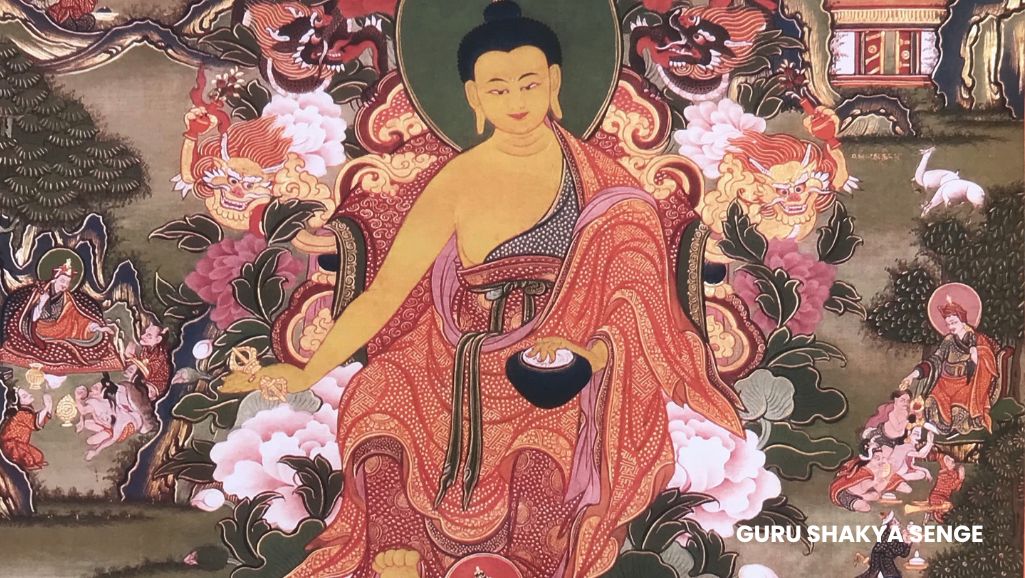
The guru Padmasambhava’s next phase was to enter monastic life. Therefore, he had to be ordained as a monk to live in a disciplined manner. The attendant of Shakyamuni Buddha, Ananda, ordained Guru Padmasambhava as a monk and gave name Shakya Simha, or Shakya Senge in Tibetan. He became identified with the tradition of Buddha. It was important to be associated with the lineage of Buddha because the main essence of the Buddha lineage was to be constant sanity. The monk must live into boundary that the monastery had permitted.
5. The Guru Padmasambhava as Raj Guru (Loden Chhoksi
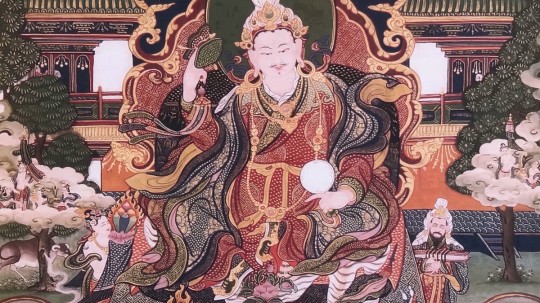
After completing monastic life, he became a great dharma master and the savior. When he was wandering in the northern Himalayan region of India reached to place at present now known as Riwalsar. The king was ruling the Riwalsar kingdom. He had the princess named Mandarava, who became a nun by leaving worldly pleasures in order to live under monastic discipline. Five hundred women guarded the princess to ensure she did not violate monastic rules. One day, the guru Padmasambhava arrived in the nunnery monastery where the princess Mandarava was living. He entered in nunnery monastery after nuns allowed him to enter, even though he was male. But no male was allowed to enter in nunnery monastery. Nuns were impressed to look him by his pure, ideal physique and great mastery of wisdom. The guru Padmasambhava converted all women to nuns. The king, Mandarava’ father, was reported by a cowherd that an unusual male voice was coming from the nunnery, preaching and shouting. The king got quite upset at the cowherd’s news and sent his minister to find out what was happening at the nunnery. Because the minister was not allowed to enter into nunnery, the king sent armies to break the nunnery gate.
The armies brought both the guru Padmasambhava and the princess Mandarava to the palace and presented them in front of the king. The king decided to execute both of them. They put the guru Padmasambhava on a pyre of sandalwood and set it afire. The princess Mandarava was thrown into a pit containing thorns, lice, and fleas. The fire in which the guru Padmasambhava had been placed burned on and on for seven days. Usually, when they executed someone criminal by fire, the fire lasted only for one or two days. The king was informed that it burned on and on. Therefore, the king sent armies to investigate. They found that the whole area where the fire had been had turned into a huge lake, and the guru Padmasambhava was sitting on a lotus in the middle of the lake. The king himself went to look, as he did not trust that his armies had said. He arrived at the scene and was overwhelmed to see the guru Padmasambhava sitting on the lotus in the middle of the lake, where a charnel ground and a place to burn criminals had been. The king confessed his wrongdoing and foolish actions; he begged pardon from the guru Padmasambhava. The princess Mandarava was pulled from the pit. After accepting invitation of the king, the guru Padmasambhava went to the palace. The king set a huge ceremony to offer respect and honour to him as Raj Guru (Lodden Chhoki) in Tibetan and offered precious jewels. Since then, the princess Mandarava became an attendant of the guru Padmasambhava.
6. The Guru Padmasambhava as Senge Dradrok
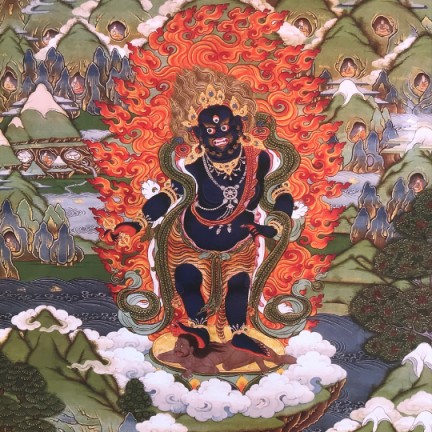
The northern region of India, now known as Bihar, was home to spiritual scholars. The territory spanned thousands of square kilometers, surrounded by dense jungle. There were Buddhist scholars and heretics, known as Tirthikas in Sanskrit. There used to take place a spiritual debate between Tirthika and a Buddhist pandit, surrounded by a huge crowd of both. Tirthikas wanted to capture all territory forcefully, pretending they won the debate despite the Buddhist pandit defeating them. Tirthkas used to claim victory in debate to expel from the territory and to establish their ashram. Buddhist scholars endured violent actions as well for a long time. Tirthikas kept Buddhist scholars under their control so that they could not develop a spiritual path.
Their dualistic philosophy must have been accepted despite it was bad by Buddhist scholars; the territory must have only been for them. They never saw others to be successful and had mountains of jealousy.
During this time, the guru Padmasambhava manifested in the form of Senge Dradrok (Lion’s Roar) to subdue Tirthikas. He destroyed all the Tirthikas’ ashrams and existence. This was how he saved Buddhist scholars from Tirthika’s demonic rule.
7. The guru Padmasambhava as Dorje Drolo
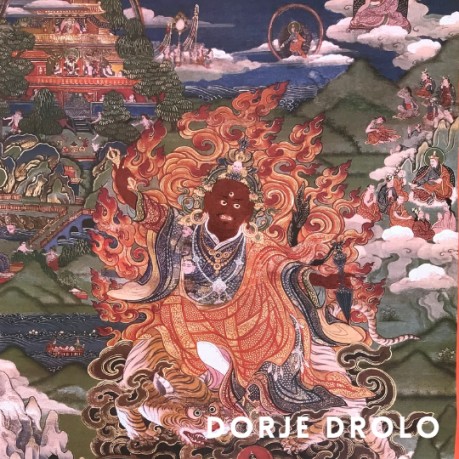
During the guru Padmasambhava was in Tibet, he had been aware that the local malevolent sprites obstructed the people of Paro valley of Bhutan. The malevolent sprites caused the climate to worsen, resulting in the land becoming deserted and the water resources drying up. The big disease epidemic spread through the Paro valley; it affected people badly.
Therefore, the guru Padmasambhava flew riding on the back of a flying tigress and landed on the cliff of the mountain of Paro valley known as Paro Tak chhang ( tigress’s nest), Bhutan. He, his Tibetan consort Yeshe Tsogyal, transformed into a flying tigress through his miraculous power to symbolize his fearless, sky-travelling activity and command over the wild forces of nature. In the Tak Chhang cliff’s cave, he meditated and then subjugated malevolent spirits. The guru Padmasambhava freed people of Paro valley from horrendous situations created by malevolent spirits.
8. The guru Padmasambhava as Nyima Oser
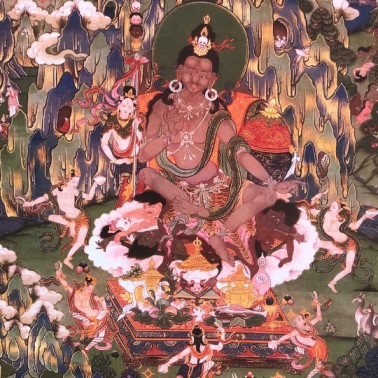
The guru Padmasambhava manifested in the form of Nyima Oser as an illuminator of Dharma, bringing wisdom to beings. He presented profound teachings in a luminous form, radiating light from his body like a sun with thousands of rays. The guru Padmasambhava was able to present physically in different times and ways, but in this aspect, he manifested in a body of light, like the morning sun, wordless, soft, and full of power to benefit beings. His brilliant teachings awakened insights of the ignorant beings just as, sun light makes things visible without force.
For further study, follow vajrayanapadma on Facebook.com.